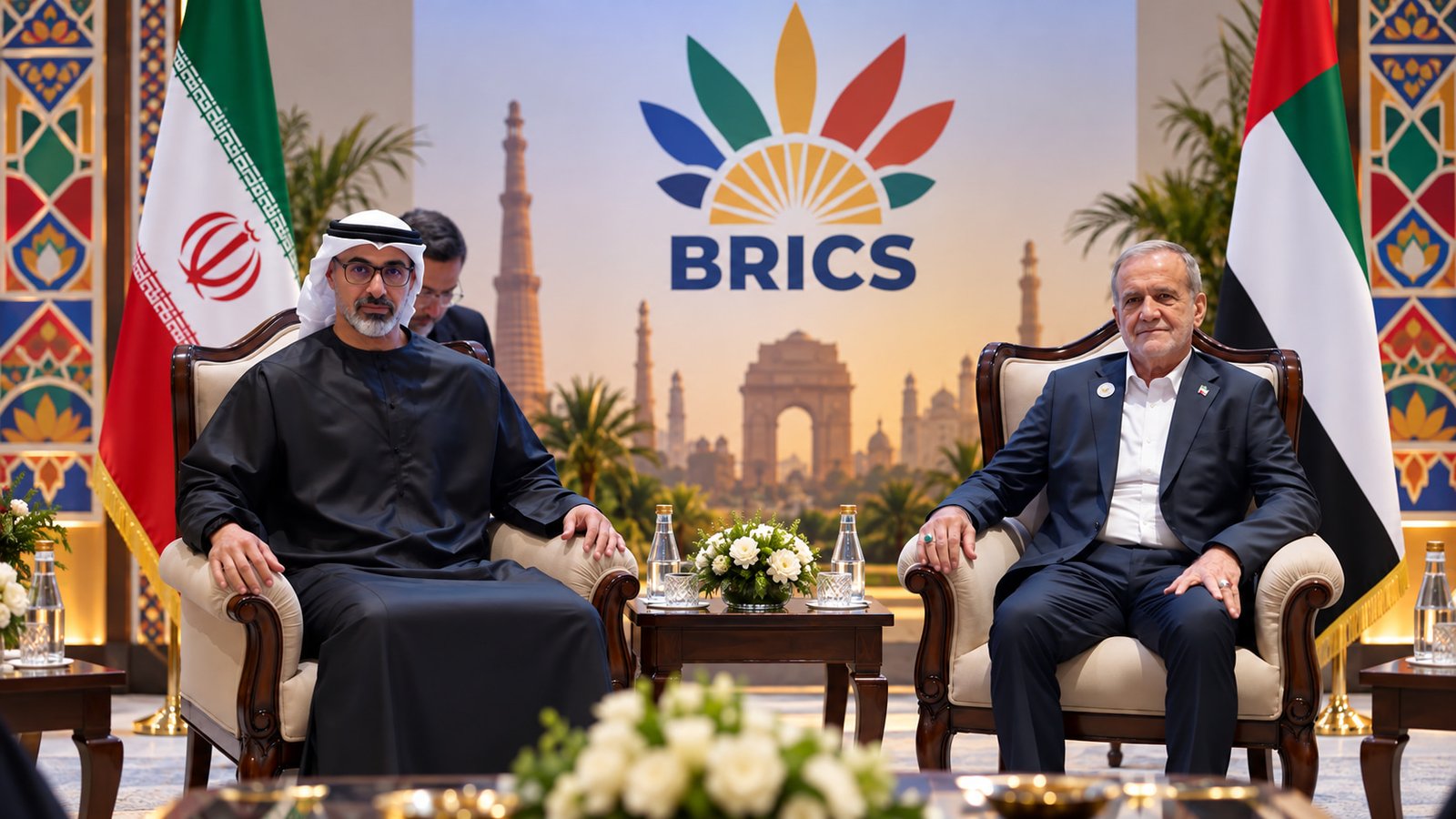
Official readouts from diplomatic meetings are designed to say as little as possible, often obscuring whether there is an Iran UAE Saudi Arabia hidden agenda at play behind renewed high-level talks.
De-escalation.’ ‘Regional stability.’ ‘Efforts to advance peace.’ When Iran’s President Masoud Pezeshkian sat down with Abu Dhabi’s Crown Prince at the BRICS summit in New Delhi this September — their highest-level contact since the two countries’ relationship soured this summer — that’s exactly the language both sides used.
It’s worth asking what that language might be covering for. Not because there’s proof of anything else going on, but because the plainly stated version of events sits awkwardly next to a few inconvenient facts.
The Official Story
On the surface, this is a simple de-escalation story. Iran and the UAE had a bad few months: renewed missile fire led the UAE to suspend trade with Tehran entirely, cutting off what had been one of Iran’s most important economic lifelines. By September, both sides were ready to talk again.
They met on the sidelines of BRICS, discussed “regional and international issues, de-escalation, stability, and efforts to advance regional peace,” and both governments signed the same New Delhi Declaration calling for restraint in the wider war.
Nothing about that account requires any hidden motive. Two neighbors with deep trade ties had a falling out and are now managing their way back from it. That’s the most straightforward reading, and it’s the one every wire report has run with.
The Inconvenient Fact Sitting Next to It
Here’s what makes the story more interesting: the UAE’s relationship with Saudi Arabia — its GCC partner and, in theory, its closest regional ally — is not in good shape either.
In January 2026, Saudi Arabia launched airstrikes on the UAE-backed Southern Transitional Council in Yemen, a group Abu Dhabi had funded and armed for years. The strikes triggered the STC’s collapse. CNN described the fallout bluntly: two of the region’s most powerful countries were now “facing off” inside Yemen, years after fighting the same war on the same side.
So at the exact moment the UAE is mending its relationship with Iran, it’s also sitting on a fresh, real grievance against Saudi Arabia. hat timing is the entire basis of the theory: does this diplomatic shift reflect an Iran UAE Saudi Arabia hidden agenda, or is it simply routine bilateral damage control?”
The Evidence: Is There an Iran UAE Saudi Arabia Hidden Agenda?
A few things make this more than idle speculation:
- Secrecy is the normal state of diplomacy, not the exception. Some of history’s most consequential realignments — the US opening to China in the 1970s as a hedge against the Soviet Union, for instance — were conducted quietly for years before being acknowledged publicly. The absence of a public statement proves nothing either way.
- “The enemy of my enemy” is a well-worn pattern in this exact region. Gulf alignments have shifted before based on shared grievances rather than shared ideology.
- The UAE has a documented motive. Saudi Arabia directly damaged a group the UAE had backed for years. That’s not a minor diplomatic slight — it’s a material loss of influence in a country the UAE has invested heavily in.
- Timing is at least suggestive. Renewed UAE-Iran contact is happening in the same window as visible UAE-Saudi friction, not years apart from it.
- “Encirclement” is already a live framing in expert analysis — just aimed at a different axis. The European Council on Foreign Relations has published analysis explicitly describing Saudi fears of “strategic encirclement” arising from a deepening UAE-Israel-Ethiopia partnership that touches Yemen, the Red Sea, and the Horn of Africa. That’s a different set of actors than Iran, but it confirms the vocabulary of encirclement isn’t a stretch — it’s already being used seriously about the UAE’s regional posture by credible foreign policy analysts.
Arguments Against an Iran UAE Saudi Arabia Hidden Agenda
Just as much evidence points the other way:
- Every available official statement describes general regional de-escalation, not anything Saudi-specific. Neither government’s public language singles out Saudi Arabia in any way.
- The UAE and Iran are not exactly warming up either. The UAE’s trade suspension with Iran remains in place. This meeting reads more like damage control between two wary neighbors than the start of an alliance.
- The UAE and Saudi Arabia remain deeply economically interlinked through the GCC, shared oil markets, and mutual investment. A full rupture would be costly for both — which argues against a UAE strategy built around isolating Saudi Arabia specifically.
- Small and mid-sized Gulf states have a long pattern of hedging, not picking sides. Oman has built its entire foreign policy around staying close to everyone and committed to no one — the UAE’s recent moves look more consistent with that regional playbook than with a targeted plan against Riyadh.
What This Probably Actually Is
The most likely explanation sits between the two extremes. The UAE doesn’t need a secret pact with Iran to send Saudi Arabia a message — simply being seen engaging with Tehran, especially so soon after the Yemen falling-out, functions as a signal on its own.
It tells Riyadh that Abu Dhabi has other options and isn’t fully dependent on the Saudi relationship. That’s a form of leverage that doesn’t require a conspiracy — just visibility, and good timing.
In other words, the UAE may not be plotting against Saudi Arabia. But it’s very plausibly making sure Saudi Arabia notices who else it’s talking to.
Why This Matters
None of this changes what was officially agreed in New Delhi, and none of it should be reported as confirmed fact — because it isn’t. But understanding the layer beneath the official statements is exactly why the Gulf’s diplomacy is so hard to read from the outside: every relationship in the region is being managed simultaneously, and a meeting billed as being “about” one country is rarely only about that country.
Whether this is coincidence, quiet leverage, or something more coordinated will likely only become clear with time — through what Saudi Arabia does next, and whether UAE-Iran contact continues to deepen or quietly fades once the immediate tension passes.
Frequently Asked Questions
Is there confirmed evidence that Iran and the UAE are working against Saudi Arabia? No. All official statements from both governments describe general regional de-escalation, not anything targeting Saudi Arabia specifically. This remains an analytical theory, not a confirmed development.
Why are UAE-Saudi relations strained? Tensions rose sharply after Saudi Arabia struck the UAE-backed Southern Transitional Council in Yemen in January 2026, a group the UAE had supported for years, effectively ending its influence in southern Yemen.
Has the UAE resolved its trade dispute with Iran? Not fully. The UAE’s suspension of trade with Iran, imposed after renewed missile fire earlier in 2026, remains in place even as diplomatic contact between the two countries has resumed.
Sources
- CNBC — Iran and UAE back joint BRICS statement urging restraint in war
- CNN — Two of the Middle East’s most powerful countries are facing off in Yemen
- CNN — Saudi Arabia’s dispute with the UAE exposes a deeper regional power struggle
- European Council on Foreign Relations — Power struggle: What the Saudi-UAE rivalry means for the Red Sea—and Europe
- The Washington Post — After Yemen rift, Saudi Arabia aims to quash UAE’s power in wider region
- Al-Monitor / Reuters — Iran and UAE back joint BRICS statement urging restraint in war
- Historical background on US-China rapprochement in the 1970s (public record)