
I’ll be honest, when I first saw the headline I scrolled past it. Border incident, happens all the time. Then I saw the location: Quneitra and Daraa in southern Syria. That made me stop.
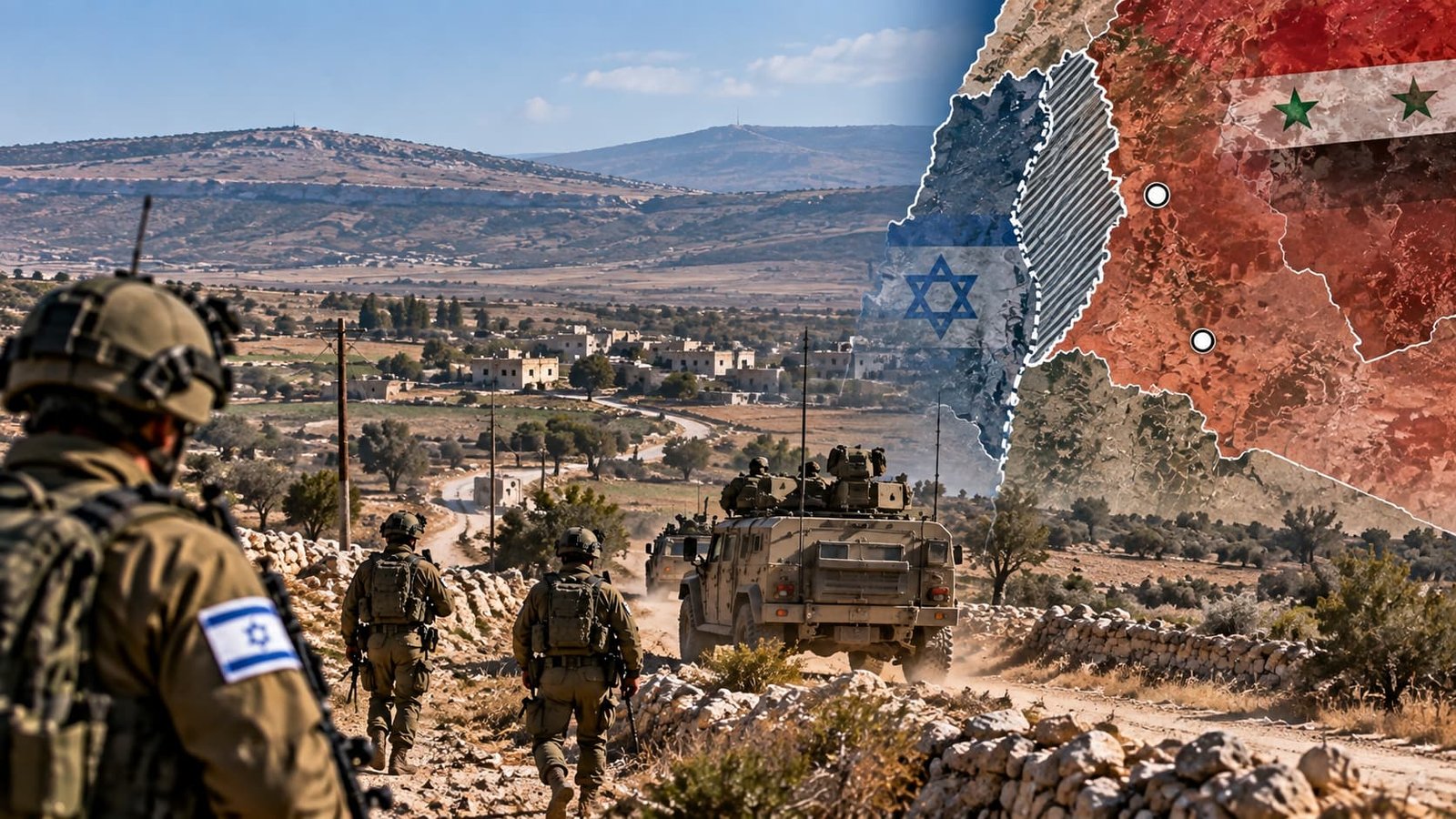
On October 3, Syria’s state news agency SANA reported that Israeli forces shelled areas in western Daraa and walked into Saida Al-Hanout in Quneitra province. SANA also says shots were fired toward residential areas, and toward journalists who were covering the operation. Keep in mind this is Syria’s version. I couldn’t find Israel’s side on this particular incident.
One incident means little. The trouble is that it isn’t one. And it lands at a bad time, because Syria is still trying to put its state institutions back together after years of war and political upheaval.
For Damascus, this goes far beyond another raid. Quneitra and Daraa sit at the center of everything Syria worries about in the south: its border, its sovereignty, and the future of the Golan Heights.
What SANA says happened in Quneitra and Daraa
According to SANA, Israeli artillery hit areas near Abidin, in the Yarmouk Basin of western Daraa, while Israeli reconnaissance aircraft were flying overhead.
In Quneitra, Israeli forces reportedly entered Saida Al-Hanout and opened fire toward residential buildings. SANA says journalists covering the operation came under fire too.
Earlier, Israeli forces had reportedly gone into Bariqa, Al-Hamidiyah and Maariya. Some Syrian residents were detained during these operations.
Small things, one after another. After a while that stops looking random. This isn’t one isolated border event, and the reports make that fairly clear.
So why is Israel operating in southern Syria?
Start with geography. Southern Syria touches the Golan Heights and the old Israel-Syria separation line. If the security situation changes on the Syrian side, Israel feels it almost immediately.
Then add December 2024, when Bashar al-Assad’s government fell. Syria entered a new political phase, but its security structure is still unsettled. Israel looks at that gap and worries about armed groups, weapons and other threats showing up close to its border. That’s the Israeli argument for continuing operations in the south.
Damascus reads the same events completely differently.
Why Does Quneitra Matter So Much to Syria?
For Syria, Quneitra and Daraa aren’t just border provinces. They’re tied to sovereignty and to whether the state can rebuild its authority at all. Here’s how I’d break it down.
1. Control of territory. If you’re running a country that just came out of years of conflict, you need to show people you actually control your own land. Repeated foreign military operations make that very hard. Damascus has objected to the Israeli activity and called it a violation of Syrian sovereignty and existing arrangements.
2. The Golan Heights. Quneitra carries extra weight because it sits right next to the Golan. Israel captured the Golan from Syria in the 1967 war and later extended its own law over it. The UN Security Council rejected that move in Resolution 497. Syria still sees the Golan as national territory and as part of any future settlement, so what happens around Quneitra means more than the villages where it happens.
3. Security rebuilding. Damascus is trying to rebuild its security institutions. An unstable south is another security problem for a government that already has plenty. UN officials have also voiced concern about the impact on communities in southern Syria and called for respect for Syria’s sovereignty and territorial integrity.
4. Political credibility. The new authorities need to show they can protect communities and manage borders. If people keep seeing foreign forces operating in their area, they’ll keep asking whether the government can really control the country.
5. Reconstruction. Syria has to rebuild cities, roads, homes and public services, and that needs a fairly stable environment. Continued military activity in the south makes it harder and adds one more layer of uncertainty for local people.
The 1974 deal everyone keeps mentioning
The Quneitra area has long been connected to the Israel-Syria separation line and the 1974 Disengagement Agreement.. It created an Area of Separation between the two sides and put limits on military forces and equipment in designated zones.
To supervise it, the UN set up UNDOF, the United Nations Disengagement Observer Force, under Security Council Resolution 350. Its job was to monitor the ceasefire and help keep things calm.
For decades this was the main tool for managing the Israel-Syria front, and it worked well enough. Can that framework still function in the very different Syria that emerged after Assad fell? Nobody really knows yet.
What actually bothers me
A single Israeli raid doesn’t mean a wider war is coming. What bothers me is the loop: Israel goes in, Syria protests, tension rises on the ground, Israel goes in again.
The longer that cycle runs, the harder it gets to bring back a stable arrangement. And that would hit Syria especially hard, because it’s already dealing with a difficult political transition and a huge rebuilding job.
Three things I’m watching
How often the operations happen. If raids and incursions keep coming, southern Syria could turn into a permanent flashpoint.
Whether Damascus can rebuild its security institutions. A stronger state would eventually have more capacity to manage its own southern border.
Diplomacy. The UN and regional governments have a real role in stopping local incidents from growing into something bigger.
Where I land
The scariest part isn’t one raid or one artillery strike. It’s the chance that repeated operations slowly become the normal reality along that border.
Israel says these operations are about its security. Syria says they challenge its sovereignty. Both positions are real and both exist at the same time, and that’s exactly why there’s no easy fix.
For Damascus, the job is to rebuild state authority and protect its territory without letting the southern border become the starting point for another major regional crisis.
I’m not Syrian, but as a Muslim I’ve followed Syria’s suffering for over a decade. Seeing people finally free of Assad, only to be frightened by foreign troops at their doorstep, is hard to watch.
So what do you think? Can Syria regain real control of its southern border while Israel still feels threatened near the Golan Heights? Drop your view in the comments.