
The geopolitical landscape of the Persian Gulf shifted abruptly as the UAE suspends trade with Iran, freezing all bilateral commercial exchanges, maritime transit agreements, and cross-border financial transactions.
Because the UAE suspends trade with Iran across all commercial sectors, this indefinite move represents one of the most severe economic disruptions in recent Middle Eastern history. The indefinite suspension of this vital commercial channel represents one of the most severe economic disruptions in recent Middle Eastern history, carrying immediate consequences for Iranian markets, regional currency stability, and maritime logistics.
1. What Triggered the Move as the UAE Suspends Trade With Iran
The UAE Ministry of Foreign Affairs announced an immediate, indefinite freeze on all direct commercial dealings and financial transactions with Tehran, citing serious escalations threatening regional stability and maritime security.
The decision followed intelligence reports and official statements regarding ballistic missile threats directed toward UAE territory. While Tehran firmly denied direct involvement—attributing the incidents to third-party provocations—the security breach pushed Abu Dhabi past its traditional policy of pragmatic economic balancing.
This economic severance comes on the heels of repeated security friction across the Persian Gulf. Although bilateral trade had previously weathered geopolitical disagreements and temporary logistical pauses, the failure of diplomatic negotiations and renewed security threats the latest escalation confirmed that the UAE suspends trade with Iran to enforce a strict, zero-tolerance national security posture.
2. Why Dubai Was Iran’s Economic Lifeline
To understand the severity of this move, one must examine the scale of economic interdependence built between the two nations over the past thirty years. The UAE was not merely a neighboring market; it functioned as Iran’s principal gateway to global commerce.
- The $30 Billion Bilateral Volume: Before the full freeze, bilateral trade between Iran and the UAE hovered around $30 billion annually, making the Emirates one of Iran’s top non-oil trading partners.
- The Premier Re-Export Hub: Nearly a third of Iran’s total non-oil imports passed through UAE ports like Jebel Ali. Critical consumer technology, automotive spare parts, industrial machinery, and textiles were routinely shipped to Dubai first, repackaged, and then ferried across the Strait of Hormuz.
- Financial Clearinghouse and Currency Access: Decades of US and international sanctions cut Iranian banks off from the SWIFT international banking system. Dubai’s extensive financial ecosystem—comprising exchange houses, trading firms, and regional holding entities—allowed Iranian enterprises to settle international accounts, convert currencies, and source essential foreign exchange reserves.
Without Dubai’s financial and physical infrastructure, Iranian commercial entities lose their most reliable channel for acquiring foreign manufactured goods and clearing international payments.
3. Direct Economic Repercussions for Iran
The reality of the UAE Iran trade freeze goes far beyond empty store shelves; it hits the core mechanics of Iran’s domestic economy.
Foreign Exchange and Currency Volatility
Dubai’s foreign exchange market heavily influenced the open-market value of the Iranian Rial (IRR). Halting financial transactions through UAE exchange networks creates immediate liquidity bottlenecks, accelerating currency depreciation and placing upward pressure on domestic inflation within Iran.
Supply Chain Shock for Industrial Sectors
While Iran produces much of its basic food supply internally, domestic manufacturing relies extensively on imported raw materials, specialized chemicals, and intermediate machinery parts routed through the UAE. Now that the UAE suspends trade with Iran, prolonged disruptions threaten to slow manufacturing output and increase production costs across domestic factories
4. Can Regional Partners Step In While the UAE Suspends Trade With Iran?
With the main maritime and financial corridor closed, Tehran is forced to accelerate its pivot toward alternative land and sea routes. However, structural and financial limitations prevent any single regional neighbor from replicating the UAE’s capacity.
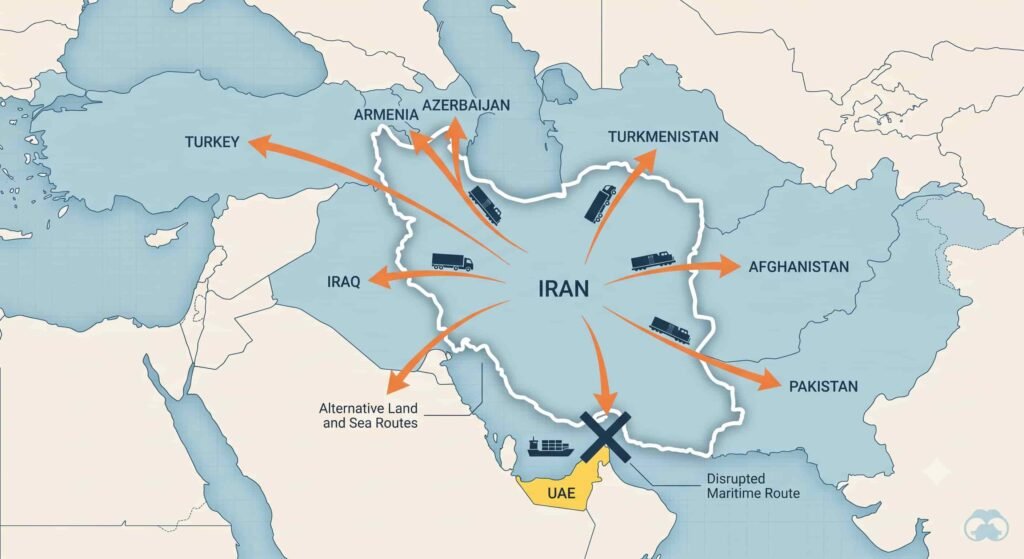
| Trade Partner | Key Strategic Opportunity | Major Structural Constraint |
| Oman | Maritime proximity across the Gulf of Oman; neutral diplomatic stance | Port capacity at Sohar and Salalah cannot match Jebel Ali; smaller banking clearing network. |
| Turkey | Established land corridors for consumer goods, textiles, and auto parts | Heavy integration with Western banking systems exposes Turkish firms to secondary sanctions risks. |
| Pakistan | Functional land borders for agricultural imports and raw materials | Internal economic constraints and limited border customs infrastructure cap volume scalability. |
| China | Massive bilateral trade partner and primary crude oil buyer | Direct overland transit links remain slow, while shipping through third-party hubs faces rising insurance premiums. |
5. The Strategic Outlook
The decision of the UAE to halt commercial operations signals a fundamental realignment in Gulf economic statecraft. In past crises, Abu Dhabi maintained commercial ties with Tehran even during intense diplomatic disagreements. By prioritizing domestic security over billions of dollars in re-export revenue, the UAE has demonstrated that regional security concerns now override traditional commercial pragmatism.
For Iran, the coming months will require building decentralized, multi-nation supply chains. While overland routes through Turkey, Pakistan, and Central Asia will prevent severe shortages of essential goods, replacing the scale, speed, and financial agility of Dubai’s global marketplace remains an insurmountable task in the near term.Saudi Arabia and the Houthis Trade Strikes: A Timeline of Escalation
Why did the UAE suspend trade with Iran?
The UAE halted all commercial, maritime, and financial operations with Iran following missile escalations and heightened security risks in the Persian Gulf, prioritizing national security over regional trade.
How does the UAE trade suspension impact Iran’s economy?
The suspension cuts off roughly $30 billion in annual trade, restricts access to international currency clearinghouses in Dubai, and disrupts the supply of industrial spare parts and consumer electronics.
Can Oman or Turkey replace the UAE as Iran’s trade gateway?
While Oman and Turkey provide secondary routes, neither possesses the combined port infrastructure, container volume capacity, and global financial liquidity that Dubai provided to Iranian merchants.