To understand why Oman and Saudi Arabia disagree, you first have to look at the map. While they share a border, a region, and membership in the same six-country Gulf bloc, their relationship is one of the Gulf’s quieter puzzles — warm enough to never break into open conflict, but distant enough that Oman rarely does what Saudi Arabia wants it to.
Here’s the full story: the religious divide most people don’t know about, a forgotten military standoff from the 1950s, and why the two countries still can’t fully agree on Yemen or Iran today.
They Don’t Even Share the Same Branch of Islam
This is the detail that explains almost everything else. Saudi Arabia is overwhelmingly Sunni. Oman is the only country in the world where the majority follows Ibadi Islam — a branch older than the Sunni-Shia split, with its own approach to leadership and religious authority.
The divide isn’t just theological trivia. Saudi Arabia’s own official fatwa body has declared that praying behind an Ibadi imam is not permissible, effectively branding Oman’s dominant faith a “deviant sect.” Compare that to Egypt’s Al-Azhar University — one of Sunni Islam’s most respected institutions — which treats Ibadism with far more scholarly tolerance. In other words, this isn’t a universal Sunni position. It’s specifically a Saudi one, and Omanis notice.
A Forgotten Border War: The Buraimi Dispute
Long before modern-day tension, Saudi Arabia and Oman had an actual military standoff — one most people have never heard of.
In August 1952, roughly 80 armed Saudi guards crossed into the Buraimi oasis, an area split between Omani and Abu Dhabi villages, and occupied the town of Hamasa. Saudi Arabia claimed the territory as part of its Eastern Province — with newly discovered oil prospects giving the claim added urgency. When arbitration talks collapsed in 1955, British-led forces backing Oman and Abu Dhabi forcibly expelled the Saudi contingent.
Saudi Arabia didn’t formally drop its claim for another 35 years. The border dispute wasn’t fully settled until 1990.
The Pattern Repeats: Why Oman and Saudi Arabia Disagree in Modern Diplomacy
Oman has never gone to war with Saudi Arabia again — but a quieter pattern of non-cooperation has continued for decades:
- 2016: When Saudi Arabia severed diplomatic relations with Iran entirely, Oman kept its ambassador in Tehran in place.
- 2017–2021 Qatar blockade: Saudi Arabia, the UAE, Bahrain, and Egypt isolated Qatar. Oman refused to join and reportedly helped Qatar reroute trade during the blockade.
- Yemen war: Oman never joined the Saudi-led military coalition against the Houthis, despite sharing a border with Yemen.
- Ongoing mediation: Oman has long served as the back-channel for secret US-Iran talks — including facilitating the 2015 nuclear deal negotiations — a role that requires staying on speaking terms with Iran rather than treating it as an enemy.
This strategic divergence is a key reason why Oman and Saudi Arabia disagree on regional security. One security analysis put it bluntly: fellow Gulf states suspect Oman of “neglecting their concerns in favor of Iran and the Houthis. Whether or not that’s fair, it’s the reputation Oman has built through decades of quiet non-alignment.
Where Oman Actually Ranks Among Gulf Allies
If Oman’s closest friend in the Gulf isn’t Saudi Arabia, who is it? A regional relationship index puts Bahrain and Kuwait — not Saudi Arabia or the UAE — as Oman’s closest Gulf partners, largely because all three share a similar instinct toward small-state neutrality rather than regional power politics.
| Gulf Country | Relationship With Oman | Why |
|---|---|---|
| Bahrain | Closest ally | Shared small-state solidarity; history of Oman mediating Bahrain-Qatar disputes |
| Kuwait | Close ally | Joint military exercises; similar neutral foreign policy instinct |
| UAE | Culturally close, politically cautious | Strong social/historical ties, but Oman avoids deep security alignment |
| Saudi Arabia | Correct but distant | Religious tension, Buraimi history, disagreement on Yemen and Iran |
Yet the Trade Relationship Is Thriving
Here’s the twist that makes this story interesting: despite all the political and religious friction, Oman-Saudi trade is not just healthy — it’s remarkably balanced.
| Metric | Figure |
|---|---|
| Total bilateral trade (H1 2026) | ~$2.8 billion (RO 1.086 billion) |
| Oman’s exports to Saudi Arabia | RO 547.6 million |
| Oman’s imports from Saudi Arabia | RO 538.6 million |
| Omani investment in Saudi Arabia | RO 115.9 million |
| Saudi investment in Oman | RO 82.69 million |
| Full-year 2025 total trade | ~$6.4 billion (RO 2.475 billion) |
Unlike the lopsided UAE-Iran or Egypt-China trade relationships, Oman and Saudi Arabia trade almost as equals — and Oman actually invests more in Saudi Arabia than Saudi Arabia invests back. Both governments are also planning joint green hydrogen projects, an electrical grid interconnection, and a proposed Gulf railway link.
September 2026: A Visit With No Big Announcement
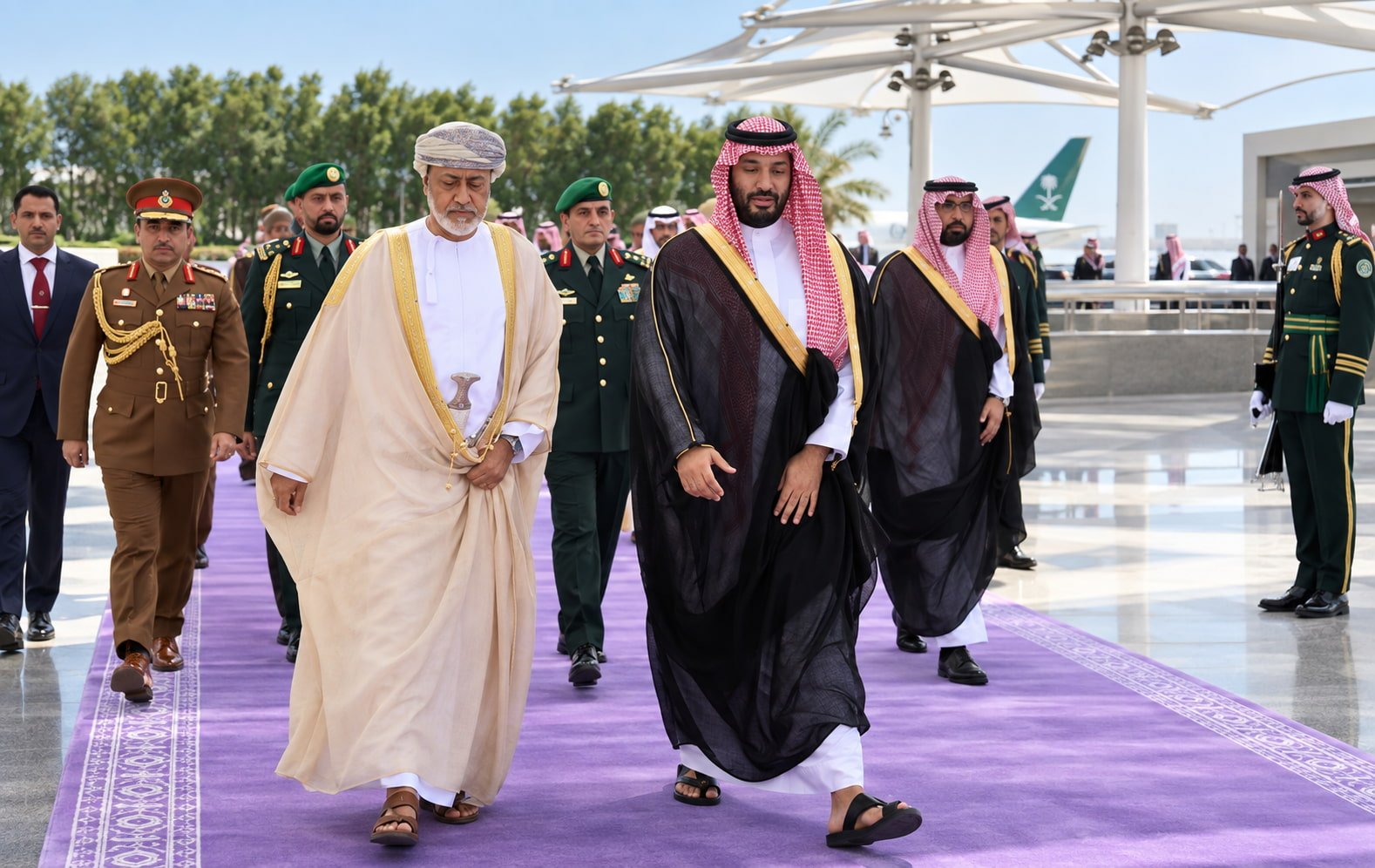
This tension is exactly why Sultan Haitham bin Tariq’s September 1, 2026 visit to Jeddah stood out — and also why it left some observers unimpressed. Unlike Xi Jinping’s Egypt visit that same week, which produced five signed agreements and hundreds of millions in new investment, the Oman-Saudi meeting produced no new deals. Official statements described only “exchanging views” on regional developments and “exploring solutions” for de-escalation.
That’s not necessarily a failure — it likely reflects the visit’s real purpose. It came shortly after a June 2026 US-Iran peace framework stalled, with Oman working alongside Qatar and Pakistan to push both sides back toward negotiations. Visits like this tend to be about maintaining trust and information channels, not signing contracts.
The Bigger Debate: Should Oman Talk to the Houthis?
Oman’s willingness to host and engage with Houthi representatives — rather than treat them purely as a hostile militia — sits at the center of a genuine foreign policy debate, not a settled question.
The case against Oman’s approach: Talking to armed non-state groups risks legitimizing them, undermines the authority of Yemen’s internationally recognized government, and could encourage other militant groups to believe that taking up arms eventually earns diplomatic recognition. Saudi Arabia’s coalition strategy — backing the recognized government militarily — reflects this position.
The case for it: Nearly a decade of military pressure hasn’t ended the Houthi’s control over northern Yemen, and mediators argue that peace processes historically require eventually talking to the fighting parties, not just the government side — as the US did with the Taliban in Doha without recognizing them as a legitimate government. Engagement, in this view, is a communication channel, not an endorsement.
There’s also an important distinction worth making clearly: Oman providing a neutral venue for talks is different from materially supporting the Houthis with weapons or funding — something Oman does not do. Critics and defenders of Oman’s approach are often talking about two different things.
Weighing It All: The Positive and the Negative
| Positive Aspects of the Relationship | Negative Aspects of the Relationship |
|---|---|
| Trade is balanced and growing (~$2.8B in H1 2026 alone) | Saudi Arabia’s official religious body has called Ibadi Islam a “deviant sect” |
| Joint infrastructure projects planned (rail, energy grid, hydrogen) | A 1952–1990 border dispute (Buraimi) once turned into an actual military standoff |
| Regular high-level diplomatic visits continue | Oman consistently avoids joining Saudi-led coalitions (Yemen, Qatar blockade) |
| Oman plays a constructive mediator role in regional crises | Fellow Gulf states suspect Oman leans toward Iran and the Houthis |
| No direct hostility or conflict in the modern era | Sultan’s 2026 visit produced no concrete agreements, unlike China’s Egypt visit |
| Omani investment in Saudi Arabia is strong and growing | Saudi visitor numbers to Oman have declined in 2026 amid regional tension |
The Bottom Line
At its core, the reason why Oman and Saudi Arabia disagree isn’t active rivalry, but deeply different worldviews. They are neighbors who’ve learned to keep the peace without fully agreeing on much.
5. FAQ Section. The friction traces back further than most people realize, to a religious divide Saudi Arabia’s own clergy has never fully accepted, and a border conflict most modern coverage has forgotten. What keeps the relationship functional isn’t shared politics — it’s trade, geography, and both sides preferring quiet coexistence over confrontation.
Frequently Asked Questions
Why do Oman and Saudi Arabia have tension? The tension traces back to religious differences — Oman is majority Ibadi Muslim, a branch Saudi Arabia’s religious authorities have called “deviant” — as well as a historical border conflict (the Buraimi dispute) and modern disagreements over Yemen and Iran.
Did Oman and Saudi Arabia ever go to war? Not a full war, but Saudi forces occupied part of the Buraimi oasis in 1952, leading to a military standoff that British-led forces resolved in 1955. The border dispute wasn’t formally settled until 1990.
Is Oman closer to Iran or Saudi Arabia? Oman maintains relations with both and avoids fully aligning with either. It kept diplomatic ties with Iran even after Saudi Arabia cut them in 2016, and frequently serves as a neutral mediator between the two.
Sources
- Reuters, Al Jazeera, The National — coverage of Sultan Haitham’s September 2026 Jeddah visit
- Oman News Agency (ONA) — official statement on the Sultan-MBS meeting
- Foundation for Defense of Democracies — analysis of Oman’s regional positioning and Gulf perceptions
- Wikipedia — “Buraimi dispute,” “Oman–Saudi Arabia relations,” “Ibadi Islam”
- Times of Israel — analysis of Oman’s post-Abraham Accords neutrality
- Oman Ministry of Commerce, Industry and Investment Promotion / Saudi General Authority for Statistics — bilateral trade data, 2025–2026