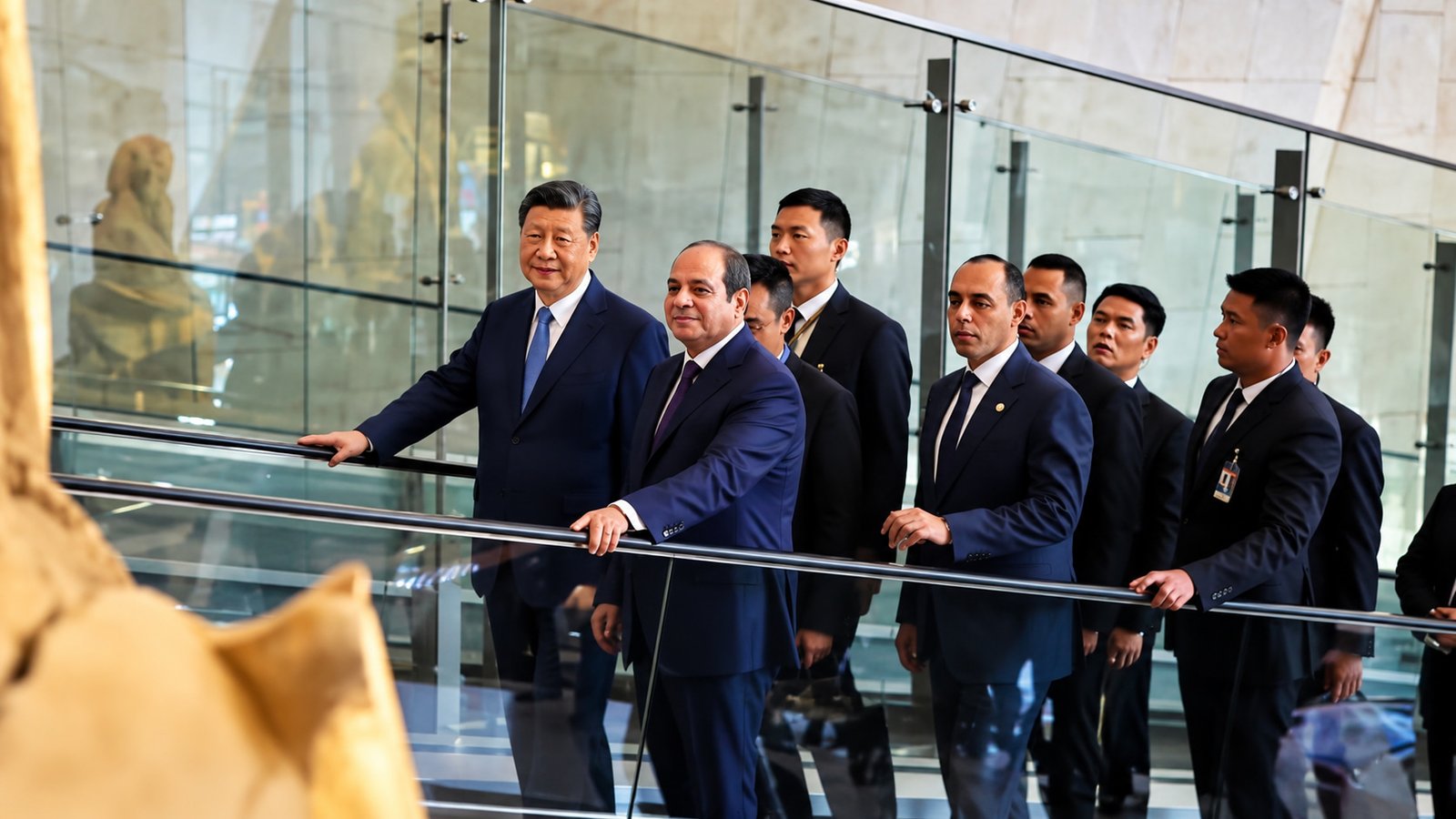
Chinese President Xi Jinping landed in Cairo on September 1, 2026, for his first visit to Egypt in a decade. On the surface, it looked like a routine diplomatic trip — red carpets, folk dancers, a 21-gun salute. Underneath, it was something bigger: China quietly expanding its footprint in a region where the United States has spent six months fighting a war, and where its own allies are starting to hedge their bets.
Xi Jinping’s Egypt Visit. Here’s everything that was signed, what it means, and why this particular moment matters.
The Headline Numbers
Xi’s two-day visit produced five formal agreements signed at Cairo’s Ittihadiya Palace, plus more than 20 additional cooperation documents covering everything from semiconductors to shipbuilding. It’s one of the largest single-visit agreement packages Egypt has signed with any foreign power in recent years.
The Five Core Agreements
| # | Agreement | Signed By | What It Covers |
|---|---|---|---|
| 1 | Vision 2030 – Belt and Road Alignment | Egypt’s FM Badr Abdelatty & China’s NDRC Chairman Zheng Shanjie | Aligns Egypt’s national development plan with China’s global infrastructure strategy |
| 2 | Economic & Technical Cooperation Agreement | Both governments | Broad-based deal expanding financial and technical ties |
| 3 | Industrial Development & Supply Chains | Both governments | Memorandum deepening manufacturing cooperation |
| 4 | Information Technology Cooperation | Egypt’s Ministry of Communications & Chinese tech regulators | Joint work on digital infrastructure and IT standards |
| 5 | Suez Canal Economic Zone Agreement | SCZone Authority & China’s Ministry of Commerce | Direct pact expanding the joint industrial zone |
The Suez Canal: The Real Centerpiece
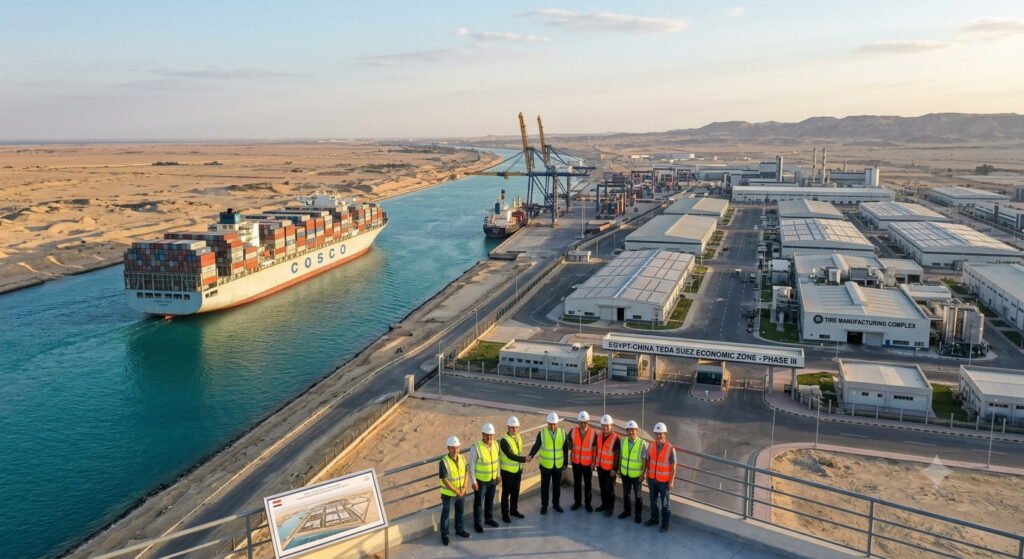
If one announcement mattered more than the rest, it was this: Egypt confirmed the third phase of the Egyptian-Chinese Suez Canal Economic Zone, an industrial area that already hosts roughly 200 companies and about $4 billion in investment.
The timing isn’t a coincidence. With the Strait of Hormuz effectively choked for months by the Iran war, global shipping has been forced to reconsider its reliance on Gulf routes. That makes the Suez Canal — and Chinese capital flowing into it — more strategically valuable than it’s been in years. China isn’t just investing in Egypt; it’s investing in an alternative artery for global trade at a moment when the usual one is under strain.
The Specific Business Deals
Beyond the government-to-government agreements, individual companies signed their own deals during the visit:
- ZC Rubber (China) signed a letter of intent with the Suez Canal Economic Zone to explore a tyre-manufacturing complex in Sokhna, estimated at roughly $500 million, with about 95% of output aimed at export markets.
- FAMSUN, a Chinese agricultural technology company, signed with Cairo 3A for a further $100 million in Egyptian investment covering agricultural machinery, grain storage, and food processing.
Both deals follow the same pattern: Chinese capital and technology, built inside Egypt, producing mainly for export to third markets — generating foreign currency for Egypt while giving Chinese companies a manufacturing base with access to African, European, and Middle Eastern markets.
What Else Was Agreed
A joint statement from both governments also committed to expanding cooperation in:
- Data centers and cloud computing
- Semiconductors and critical metals supply chains
- Renewable energy and AI
- Trade settled in national currencies rather than the US dollar
- Maritime shipping security, with China offering to help safeguard routes affected by the Iran war
Egyptian President Abdel Fattah el-Sisi also proposed deepening military and security exchanges — notable given that a joint Egyptian-Chinese air force exercise, “Eagles of Civilisation,” had already launched on August 22, just before Xi’s arrival.
The Trade Imbalance Behind the Handshakes
For all the diplomatic warmth, the underlying trade relationship is lopsided. In the first half of 2026, Egypt exported $840.8 million worth of goods to China — mostly fuel and mineral oils, fruits and vegetables, and cotton. Here’s the full breakdown:
| Product Category | Export Value (H1 2026) |
|---|---|
| Fuels, mineral oils & distillation products | $494 million |
| Vegetables and fruit | $150.6 million |
| Cotton and textile fibres | $76.4 million |
| Natural calcium phosphates | $31 million |
| Organic/inorganic chemicals | $21 million |
In the same period, Egypt imported $10.4 billion from China, dominated by electrical machinery ($4.1 billion), vehicles ($1.2 billion), iron and steel ($930.7 million), and plastics ($524 million).
That’s a trade deficit of roughly $9.6 billion in China’s favor, with Egypt importing more than 12 times what it exports. Egyptian exports did jump nearly 200% year-on-year, largely because China began granting zero-tariff access to Egyptian goods starting May 1, 2026 — but the gap remains enormous. The manufacturing-for-export deals signed during this visit are, in part, Cairo’s attempt to chip away at that imbalance by getting Chinese factories built on Egyptian soil rather than just shipping finished goods in.
Seventy Years in the Making
This visit didn’t happen in isolation — it’s the latest chapter in a relationship that’s been steadily deepening since 1956, when Egypt became the first Arab and African country to establish diplomatic ties with the People’s Republic of China. That early bond was cemented the same year, when China backed Egypt during the Suez Crisis, as Britain, France, and Israel moved against Cairo over the canal’s nationalization.
From there, the relationship expanded gradually rather than dramatically: a 1999 strategic partnership agreement, a 2014 upgrade to a “comprehensive strategic partnership” during el-Sisi’s first China trip, and now, in 2026, this latest package arriving on the 70th anniversary of formal ties.
Unlike some of China’s other regional relationships, this one has been marked less by dramatic swings and more by steady, incremental deepening — economic ties, military exercises, education exchanges, and now a shared industrial zone on one of the world’s most important trade routes.
The Relationship Has a Darker Chapter Too
The 70-year story isn’t entirely one of smooth, steady friendship. In July 2017, Egyptian police detained more than 200 Uyghur Muslims — many of them students at Al-Azhar University, Cairo’s centuries-old center of Islamic learning — in raids on Uyghur homes, restaurants, and gathering spots. At least 36 were forcibly deported back to China, against their will.
The crackdown followed a meeting just weeks earlier between Egypt’s Interior Ministry and a Chinese deputy public security minister, in which China pushed for information-sharing on what it called “extremist organizations.” None of the detained students were shown to have any formal charges against them — being Uyghur and studying religion at Al-Azhar appears to have been enough to draw suspicion.
The optics were hard to miss: on the same day some students were being deported, a China-sponsored Uyghur dance troupe was performing at the Cairo Opera House, showcasing Xinjiang’s “colorful culture” to Egyptian audiences.
Human Rights Watch condemned the deportations and called on Egypt to halt them. Some of the detained students reportedly held UNHCR asylum documentation, but Egypt — which has no domestic asylum law of its own — offered them no legal protection.
Researchers tracking this pattern have found the Middle East to be the region with the highest number of documented cases of countries assisting China in detaining or deporting Uyghurs — Egypt’s case is the most prominent, but not the only one.
It’s a reminder that the steady warmth between Cairo and Beijing has, at least once, come at a real human cost — one that rarely gets mentioned alongside headlines about pipelines, ports, and industrial zones.
Why Now, Specifically
Xi’s visit lands at a genuinely unusual moment. The US-Israel war with Iran has run for six months, rattling every US ally in the region and pushing countries to hedge rather than rely on a single security guarantor.
Egypt, one of the largest recipients of US military aid at $1.3 billion annually, has stayed carefully neutral throughout the conflict — condemning Iranian strikes on Gulf states while also publicly urging Washington to end the war.
That balancing act is exactly what makes Egypt attractive to Beijing right now. As one Middle East analyst put it, China sees Cairo as a strategic power broker — a country with ties to Washington, a mediating role between Israel and Palestinian groups, and control of one of the world’s most critical waterways. For Egypt, closer ties with China aren’t about picking a side; they’re about not depending entirely on one.
There’s a sharper edge to this too: both Egypt and China are currently facing the threat of US sanctions tied to financial links with Iran, with Washington reportedly moving to restrict operations at Egypt’s Banque Misr. That shared pressure adds another layer to why this visit, and its timing, matters well beyond the ceremonial handshakes.
The Bottom Line
Xi’s Egypt trip produced real, substantial agreements — not just symbolic gestures. A $4 billion industrial zone expanding into its third phase, hundreds of millions in new manufacturing investment, and a broader framework tying Egypt’s development plans to China’s global infrastructure ambitions.
But it also reflects something larger: in a region where the reliability of the traditional security guarantor is being openly questioned, countries like Egypt are quietly building alternatives — without fully walking away from Washington.
Sources
- Al Jazeera — China’s Xi visits Egypt’s el-Sisi: Why it matters
- Al Jazeera — China’s Xi urges new Middle East security framework during rare Egypt visit
- NPR — Xi visits Egypt as China seeks deeper influence across the Mideast
- ABC News — Xi visits Egypt as China seeks deeper influence across the Mideast
- Middle East Eye — Xi’s Egypt visit tests Cairo’s balancing act
- Africanews — Xi Jinping visits Grand Egyptian museum as China and Egypt deepen strategic ties
- Wikipedia — 2026 state visit by Xi Jinping to Kyrgyzstan and Egypt
- Human Rights Watch (July 2017) — Reporting on Uyghur detentions and deportations from Egypt
- Woodrow Wilson Center — Research on Middle East states’ cooperation with China on Uyghur detentions
- CAPMAS (Egypt’s Central Agency for Public Mobilization and Statistics) — Bilateral trade data, H1 2026
How many agreements did Egypt and China sign during Xi Jinping’s visit?
formal agreements were signed, along with more than 20 additional cooperation documents covering trade, technology, industry, and supply chains.
What is the Suez Canal Economic Zone deal?
Third phase of their joint industrial zone at the Suez Canal, which already hosts around 200 companies and roughly $4 billion in investment.
What is the trade balance between Egypt and China?
deficit with China — it exported $840.8 million to China in the first half of 2026 while importing $10.4 billion, a gap of about $9.6 billion.