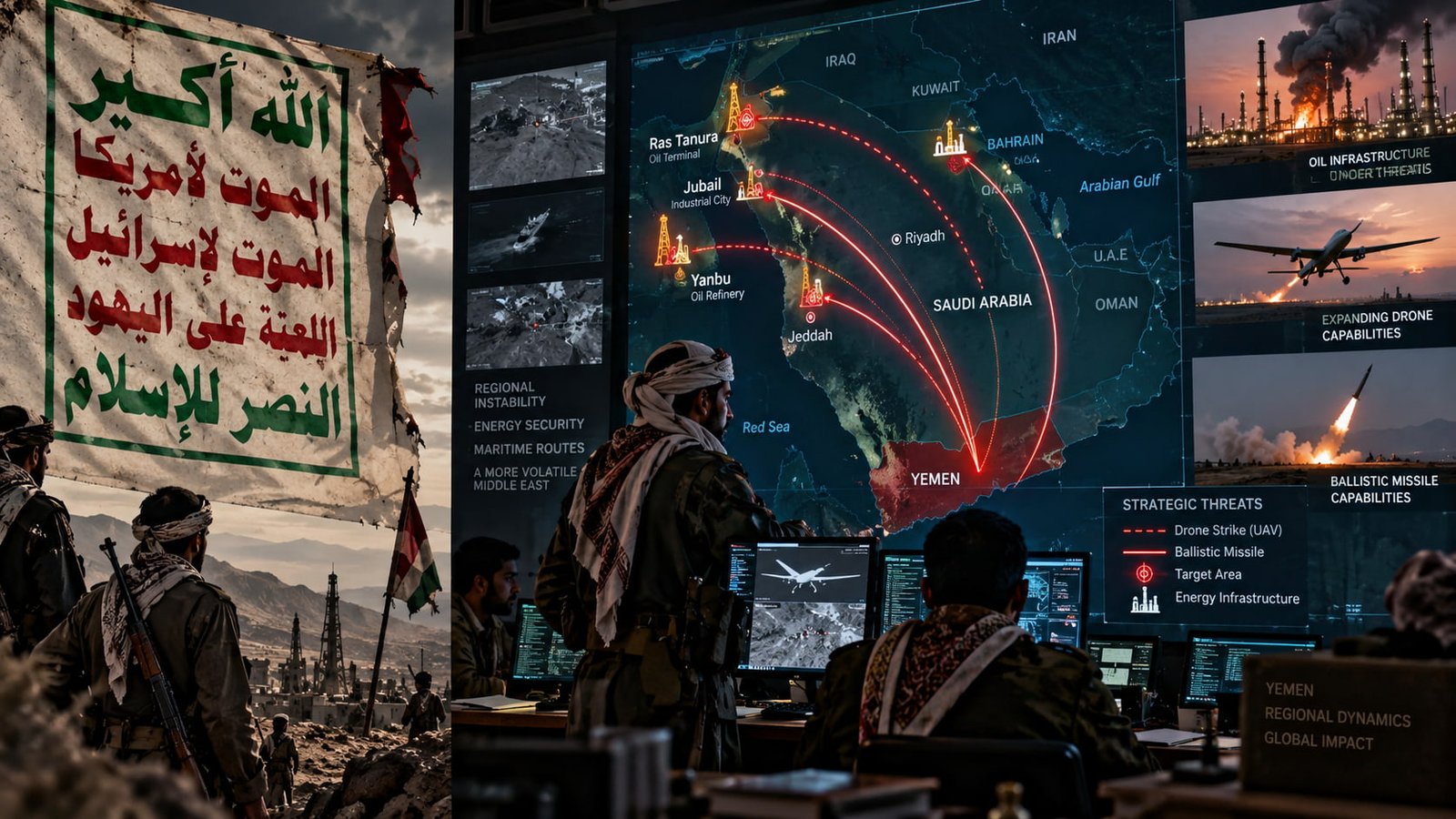
Every Houthi banner bears the same five lines: “God is the Greatest, Death to America, Death to Israel, A Curse Upon the Jews, Victory to Islam.” This chant echoes at mass rallies across Yemen, adorns missile fuselages, and anchors political declarations from Sanaa to Tehran.
However, looking past the loud political theatrics exposes the stark Houthi slogan reality, where ideological declarations clash directly with day-to-day military actions. Understanding this Houthi slogan reality requires an objective examination of strike inventories, secret diplomatic pacts, and target selections.
When investigators analyze declassified strike logs and backchannel negotiations, the true Houthi slogan reality becomes undeniable. While the rhetoric vows total destruction to Western powers, the operational Houthi slogan reality proves that neighboring Arab states—not distant adversaries—absorb the primary impact of their kinetic arsenal.
What Is the Origin of the Houthi “Sarkha” Slogan?
The rallying cry—known as the Sarkha—did not originate in northern Yemen. It traces back to the 1979 Iranian Revolution, serving as the ideological bedrock of the Islamic Republic. Over four decades, Tehran exported this messaging template to regional proxies, including Hezbollah in Lebanon, Shia militias in Iraq, and Ansar Allah (the Houthis) in Yemen.
1979 Iranian Revolution ──► Ideological Export ──► Regional Proxies (Hezbollah, PMF, Houthis)
                                                          │
                                                          ▼
                                            Pan-Islamic Anti-Western Narrative
This shared branding serves a clear strategic purpose: it reframes localized conflicts into an existential, pan-Islamic struggle against external powers like the US and Israel. By adopting this stance, the group secures ideological backing across the broader Muslim world while consolidating local control.
The Houthi Slogan Reality: Strike Data vs. Public Rhetoric
Strike records consistently diverge from the official slogan. Tracking drone and ballistic missile trajectories reveals the movement’s true tactical priorities.
| Target Region | Munitions Directed | Primary Operational Targets | Strategic Objective |
| Israel & US Assets | ~850 missiles and drones | Remote desert outposts, symbolic maritime targets | Ideological messaging, public deterrence |
| Gulf & Arab States | 4,911 missiles and drones | Energy infrastructure, commercial ports, urban centers | Regional leverage, economic pressure |
Deploying nearly six times more firepower against Arab neighbors than against Israel directly challenges the public narrative. If the operational objective were confronting non-Muslim external adversaries, deployment patterns would reflect that focus. Instead, regional Muslim-majority states absorb the overwhelming bulk of the kinetic output.
Backchannel Diplomacy: Exposing the Houthi Slogan Reality in Oman
Backchannel diplomacy in Muscat, mediated by Omani officials, provides direct insight into the gap between public rhetoric and tactical concessions:
- Naval Passage Guarantees: Delegations discussed halting strikes against US and Israeli-linked vessels in international corridors.
- Sustained Targeting of Arab Ships: Negotiators maintained that Saudi and regional Arab commercial vessels remained active military targets.
- Exclusion of Regional Allies: Arab neighbors bearing the operational fallout were not included in the private arrangements.
Securing tactical arrangements concerning Western adversaries while keeping neighboring Arab states in the crosshairs demonstrates that the slogan operates as political theater rather than an unbending military doctrine.
Why Do Iran-Aligned Proxies Target Arab Neighbors Instead of Direct Adversaries?
This targeting pattern follows a multi-decade operational doctrine prioritizing the “Near Enemy” (local governments) over the “Far Enemy” (the US and Israel):
- Internal Yemeni Conflict: Before launching Red Sea operations, Houthi forces spent a decade fighting Yemen’s recognized government, impacting local civilian infrastructure.
- Domestic Leverage in Lebanon: Hezbollah prioritized consolidating domestic dominance and securing parallel security networks over open-ended conflict across the southern border.
- Paramilitary Expansion in Iraq: Tehran-aligned militias focused tactical operations on countering sovereign state institutions and local opposition.
Confronting the United States or Israel directly risks overwhelming conventional retaliation. Targeting neighboring Arab states allows regional proxies to operate within an asymmetric “gray zone,” applying pressure on vital transit routes and energy infrastructure.
What Happens When Armed “Resistance” Factions Take Administrative Power?
When ideological insurgencies transition into territorial administrators, the resulting governance model prioritizes military consolidation over public infrastructure.
| Governing Authority | Operational Framework | Administrative Outcome on the Ground |
| Houthis (Yemen) | De facto rule in Sanaa | Severe economic contraction, diversion of state revenue to munitions programs |
| Hezbollah (Lebanon) | Dominant political/military force | Paralyzed state institutions, banking collapse, isolated parallel economy |
| PMF (Iraq) | State-sanctioned paramilitary bloc | Siphoning public oil revenues, parallel command authority |
| Assad-Aligned Axis (Syria) | State-level military intervention | Mass displacement, urban destruction, securing proxy transit corridors |
When municipal services deteriorate and economic pressures rise, administrative authorities routinely invoke external “resistance” slogans to suppress internal domestic accountability.
Why Does the Anti-Israel Slogan Remain in Use?
Framing territorial expansion as anti-imperialist resistance generates ideological legitimacy and international coverage. Slogans highlighting control over local shipping corridors and regional energy nodes do not elicit broad ideological sympathy.
While the banners declare war on distant powers, operational inventories and diplomatic agreements demonstrate that the weapons remain focused on the immediate neighborhood.
Do Houthis follow their own slogan in military operations?
No. Strike data shows Houthi forces have directed nearly six times more missiles and drones at regional Arab states (4,911 munitions) than at US or Israeli assets (~850 munitions), despite banners declaring “Death to America, Death to Israel.”
What does the Houthi “Sarkha” slogan mean?
Direct strikes against the US or Israel carry risks of severe conventional retaliation. Targeting neighboring Arab states allows the group to operate in an asymmetric gray zone, applying leverage on global energy corridors and regional trade with lower existential risk.
Did the Houthis negotiate maritime passage in Oman?
Yes. Diplomatic talks mediated by Oman between Houthi representatives and Western officials involved guarantees for international vessels, while regional Arab shipping was explicitly kept within their declared targeting scope.