
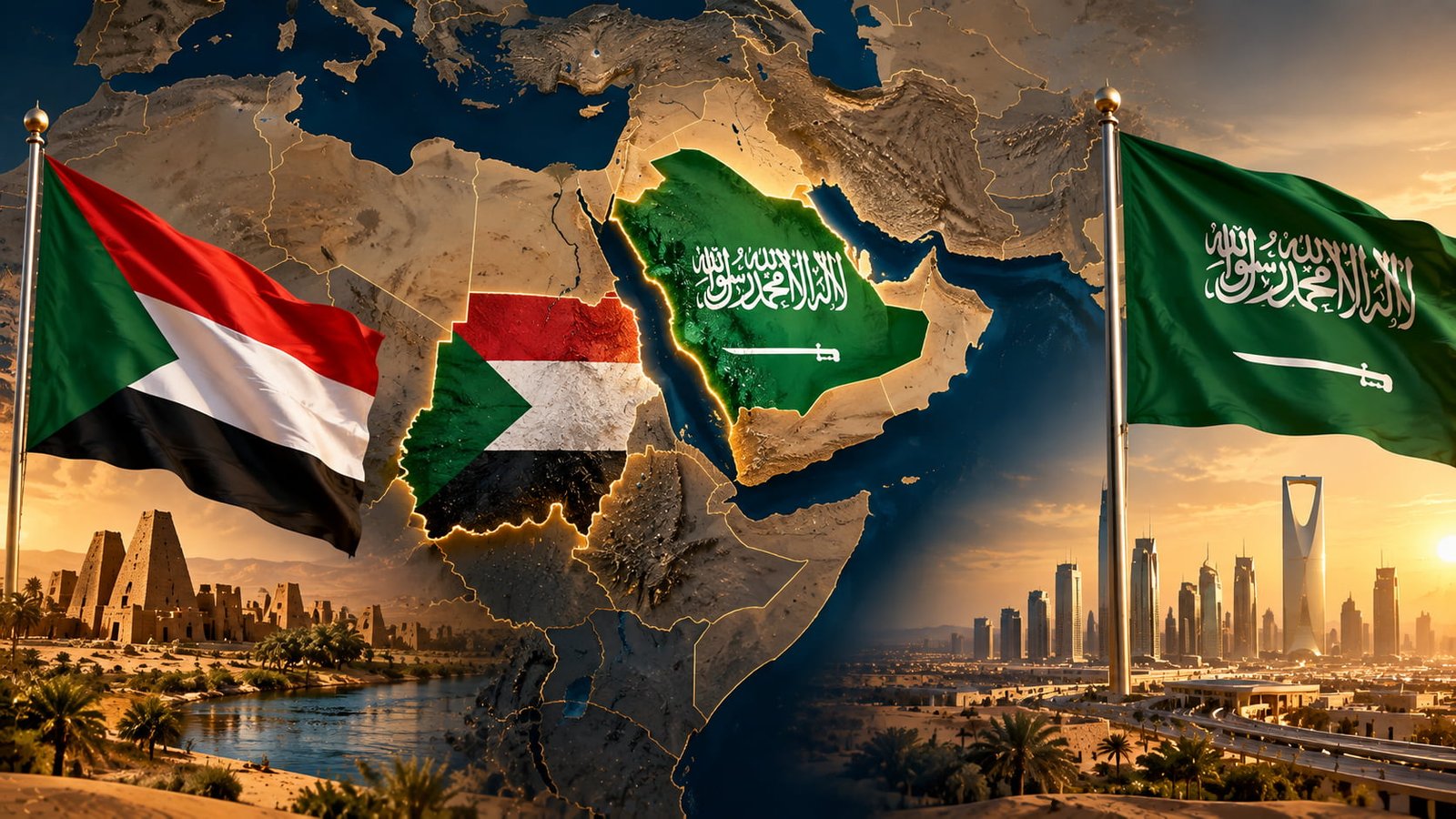
The Saudi Arabia Sudan war story is often told as a simple fight between an army and a militia. In reality, Sudan’s civil war, which began in April 2023, has become a regional contest involving Gulf powers with competing interests. Saudi Arabia says it is neutral and focused on mediation. Yet it maintains close ties with the Sudanese Armed Forces (SAF), while the UAE is widely accused of backing the rival Rapid Support Forces (RSF). This analysis explains what Saudi Arabia is doing in Sudan, why, and who pays the price.
What Is Saudi Arabia Doing in Sudan?
Saudi Arabia has provided political and financial support to the SAF in its war against the RSF, according to Africanews. It has also acted as a leading mediator alongside the US, Egypt and the UAE.
Riyadh officially denies supporting any party. Its stated role is mediation and regional stability, as reported by The Standard. Critics question that neutrality, pointing to Riyadh’s ties with SAF leadership. That same report notes the U.S. Africa Command’s magazine described these long-standing relations but offered no evidence of direct operational support.
Who Are the SAF and RSF, and Why Are They Fighting?
The SAF is Sudan’s regular army, led by General Abdel Fattah al-Burhan. The RSF is a paramilitary force led by Mohamed Hamdan Dagalo, known as Hemedti. Its roots lie in the Janjaweed militias used in Darfur in the 2000s. The two forces once cooperated, but a power struggle turned into open war in April 2023.
The SAF is the internationally recognized military authority, while the RSF has no formal recognition. Both sides face serious allegations of abuses against civilians.
Why Does Saudi Arabia Support the Sudanese Army?
Analysts point to several overlapping reasons.
1. Long-Standing Military Ties
Sudan sent troops to the Saudi-led coalition in Yemen from 2015, building institutional trust between the two militaries. Burhan has also visited Saudi Arabia several times since the war began, including a meeting with Crown Prince Mohammed bin Salman, according to Noon Post.
2. Red Sea Security and Vision 2030
From Riyadh’s perspective, the war has outgrown Sudan’s borders. Its effects run from the Red Sea into central Africa and touch Saudi security priorities and Vision 2030 goals. A friendly, stable Sudanese state is safer for Saudi interests than a fragmented one.
3. The Saudi-UAE Rivalry
Many observers describe Sudan as a proxy arena for Saudi-UAE competition, as the Sasakawa Peace Foundation analysis notes. Tension between the two escalated after a UAE-backed faction moved against Saudi-aligned forces in Yemen in December 2025, according to the Arab Reform Initiative. Sudan became one of the places where that rivalry could play out.
4. Economic Interests
Saudi-Sudan trade is estimated at $8 billion, mainly livestock and agricultural imports, and a business forum in Riyadh was planned for June (Africanews).
Why Would One Arab State Back a Group Fighting Another Arab Group?
This is a common question, and the answer is that state interests outweigh Arab solidarity. Gulf states choose partners by security, economics and rivalry, not shared identity. The same Saudi-UAE split appeared in Yemen, where each backed different factions. For Saudi Arabia, the SAF is a state institution and a predictable partner. For the UAE, critics say the RSF serves its strategic and commercial interests, though the UAE denies arming the group.
How Has the Iran War Changed Saudi Policy?
US and Israeli strikes on Iran on 28 February 2026, and Iran’s retaliation against Gulf territory, changed the regional picture. The Arab Reform Initiative analysis says this disrupted the escalating Saudi-UAE competition and made Riyadh noticeably more cautious in its backing of the SAF.
What Has Saudi Arabia Said Publicly?
In February 2026, the Saudi Foreign Ministry condemned RSF attacks in Kordofan and criticized “foreign interference,” including the flow of illegal weapons and mercenaries, according to Al Jazeera. It also reaffirmed support for Sudan’s territorial unity.
SAF vs RSF: Quick Comparison
| Factor | SAF | RSF |
|---|---|---|
| Status | Internationally recognized army | Paramilitary, no formal recognition |
| Main external backer | Saudi Arabia (denies taking sides) | UAE (denies arming) |
| Power base | Northern and riverine Sudan | Darfur and western Sudan |
| Origin | Traditional state military | Evolved from Janjaweed militias |
| Concerns raised | Airstrikes, civilian harm, blockades | Ethnic violence, mass displacement |
How Are Ordinary Sudanese Affected?
Most civilians did not choose this war. Poverty, tribal pressure and nationalist rhetoric push many toward armed groups, while those who stay neutral risk being targeted by both sides. Millions have been displaced, making this one of the world’s largest displacement crises.
Conclusion
Saudi Arabia’s role in Sudan blends historic military ties, Red Sea security, economic interests and rivalry with the UAE. Riyadh calls itself a neutral mediator, but its closeness to the SAF is hard to ignore. Meanwhile, civilians carry the heaviest cost of a war shaped by outside competition.
Sources
- The Standard: Riyadh influence in Sudan war
- Noon Post: Saudi Arabia’s Sudan Strategy
- Africanews: Sudan’s military chief meets Saudi Crown Prince
- Africa Confidential: Saudi Arabia
- Sasakawa Peace Foundation analysis
- Arab Reform Initiative: Paused, Not Resolved
- Al Jazeera: Saudi Arabia denounces “foreign interference”
People Also Ask: Frequently Asked Questions
Is Saudi Arabia fighting in the Sudan war?
No. Saudi Arabia is not reported to be fighting directly. It offers political and financial backing to the SAF while presenting itself as a mediator.
Which side does Saudi Arabia support in Sudan?
Saudi Arabia is widely reported to lean toward the SAF, though it officially denies supporting any party.
Who supports the RSF?
The UAE is accused of supplying the RSF with money and weapons, which it denies.
Why is the Sudan war called a proxy war?
Because rival Gulf powers back opposing sides, and their competition over the Red Sea and Horn of Africa shapes the conflict.
When did the Sudan war start?
In April 2023, when fighting broke out between the SAF and the RSF.