So what is OPEC and OPEC+? The short version: OPEC is the original bloc formed to protect oil revenue, while OPEC+ is the wider alliance built around it years later. But the full story starts in a conference room in Baghdad, September 1960. Five oil ministers, one shared grievance, and a decision that still shapes what you pay at the pump today. That’s really where this story starts — and it explains a lot about why Gulf tensions, gas prices, and headlines about “OPEC+” all connect back to the same root.
The Event That Created OPEC
Before 1960, oil-producing countries had almost no say over what their own oil sold for. That power sat with seven Western companies — the “Seven Sisters” — now known by names like ExxonMobil, Chevron, Shell, and BP. They set prices unilaterally. Producing nations found out after the fact.
Then, in August 1960, those companies cut posted oil prices again, without warning, for the second time in under two years. Governments whose entire budgets depended on oil revenue watched their income drop overnight. That was the breaking point. Oil ministers from Saudi Arabia, Iran, Iraq, Kuwait, and Venezuela met in Baghdad from September 10 to 14, 1960, and founded OPEC.
The logic was blunt: alone, these countries had no leverage. Together, they might finally have some.
Who’s in OPEC Today
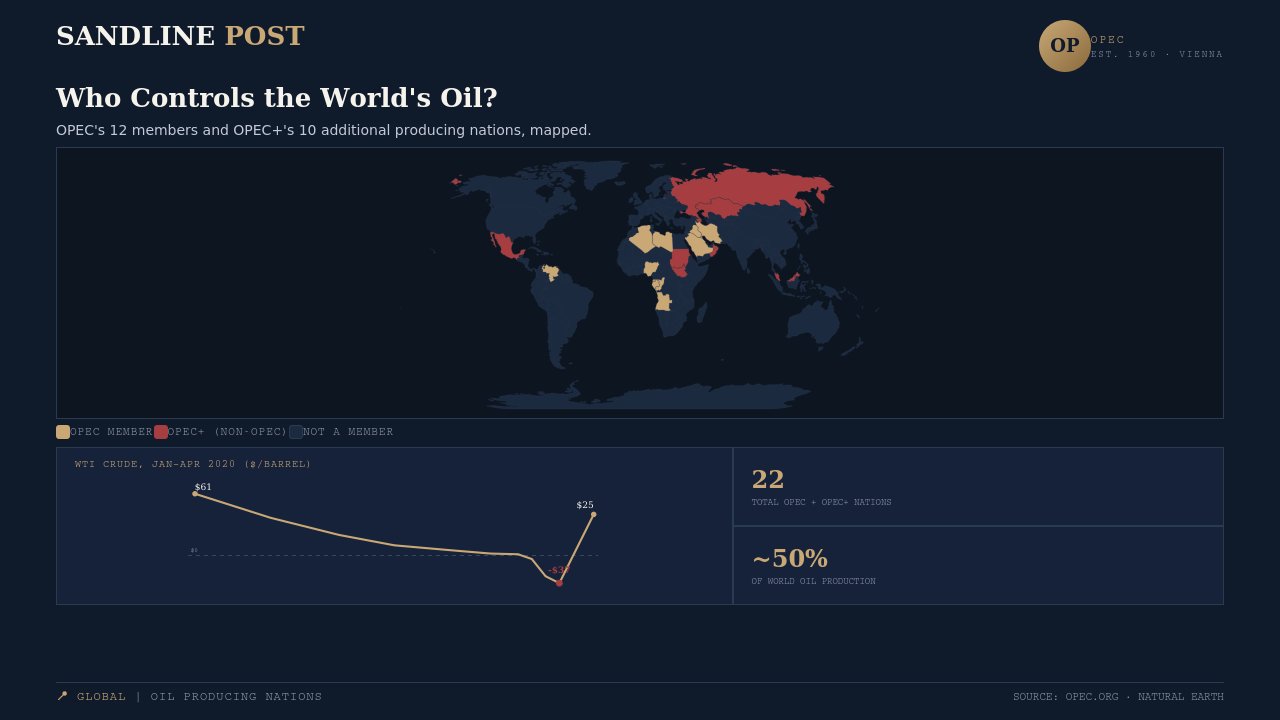
Twelve countries remain: Saudi Arabia, Iran, Iraq, Kuwait, Venezuela, Nigeria, Algeria, Angola, Libya, Congo, Equatorial Guinea, and Gabon. The UAE walked away in 2026, after mounting friction with Saudi Arabia over regional policy and a broader push toward a more independent foreign policy.
Qatar left back in 2019 to double down on natural gas instead. Ecuador and Indonesia have both left and rejoined more than once, usually over disputes about quotas or membership costs.
Even with those exits, the group’s weight is still hard to overstate — OPEC’s own figures put member countries at close to 80% of the world’s proven oil reserves and roughly 40% of global crude supply. Day-to-day, it’s run out of a Secretariat in Vienna, currently led by Secretary General Haitham al-Ghais.
OAPEC Is a Different Thing Entirely
People mix up OPEC and OAPEC constantly, so it’s worth clearing up. OAPEC — the Organization of Arab Petroleum Exporting Countries — was formed in 1968, and it’s Arab-states-only, with a narrower job: technical and economic cooperation among Arab nations, not global price coordination. Membership overlaps a lot with OPEC’s Arab members, but it’s a separate organization running its own projects, including regional shipbuilding and development work.
Why OPEC+ Had to Happen
Fast forward to the 2010s. US shale production had exploded. Russia was pumping more oil than ever. If OPEC cut output to prop up prices while non-members kept flooding the market, the whole strategy would be pointless.
So in 2016, OPEC struck a wider arrangement with 10 non-member producers, Russia chief among them. Everyone calls it OPEC+; OPEC’s own paperwork calls it the Declaration of Cooperation, or DoC. It isn’t a treaty. There’s no legal obligation binding anyone to it — countries coordinate production because it suits them, not because they’re contractually stuck.
The other nine are Kazakhstan, Azerbaijan, Mexico, Oman, Bahrain, Malaysia, Brunei, Sudan, and South Sudan. In practice, Russia’s output dwarfs the rest combined, which is why every OPEC+ headline eventually comes down to what Saudi Arabia and Russia decide between themselves.
There’s Also a Development Bank You Probably Haven’t Heard Of
OPEC runs something separate from oil policy altogether: the OPEC Fund for International Development, set up in 1976. It’s based in Vienna too, but it’s a development finance institution — it funds infrastructure, healthcare, and education projects in developing countries outside the OPEC bloc.
It’s a useful reminder that OPEC’s founders weren’t only thinking about oil prices. During an era of decolonization, they saw themselves as speaking for the developing world more broadly.
So Why Didn’t Everyone Just Join OPEC?
Each holdout has its own story.
Mexico kept its oil industry entirely state-run through Pemex and never wanted to be seen as part of a cartel — not with an economy this tied to the US. Kazakhstan and Azerbaijan only became serious producers after the Soviet collapse, and their oil sectors lean heavily on Western investment from companies like Chevron and BP, investors who might get nervous about formal cartel membership.
Oman was politically closed off under an old Sultanate when OPEC formed and never joined once it opened up. Bahrain’s reserves are mostly spent at this point — it’s more of a refining hub now than an exporter. Malaysia and Brunei sit in a completely different orbit, geographically and politically closer to Southeast Asia than the Gulf.
OPEC’s own rules require new members to have “fundamentally similar interests” to existing ones, plus majority approval. That’s a hard bar to clear for a country whose economic interests point toward Washington or a Western oil major rather than Riyadh.
When Cooperation Breaks, Everyone Loses
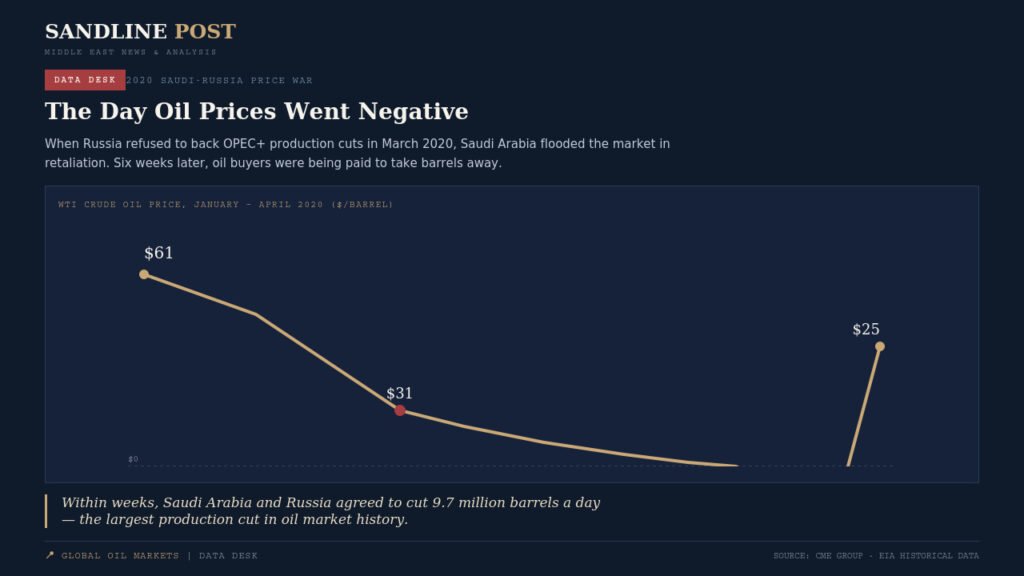
OPEC+’s flexibility cuts both ways, and nothing proved that like March 2020. Russia refused to back deeper cuts as COVID-19 gutted demand. Saudi Arabia’s response was to flood the market with cheap oil — punishment, essentially. Prices collapsed 65% in a single quarter. On April 20, 2020, oil briefly traded negative for the first time ever; traders were paying buyers to take barrels off their hands because storage had run out.
Both sides got hurt badly enough that within weeks they were back at the table, agreeing to the largest production cut in history — 9.7 million barrels a day. The lesson stuck: nobody in OPEC+ is bound by contract, only by whatever self-interest currently aligns. Break that alignment, and cooperation collapses fast — until the pain becomes bad enough that everyone crawls back.
OPEC Has Never Been Universally Loved
For all its influence, OPEC has spent decades fielding criticism — some of it from the very countries it does business with, some of it from inside its own ranks.
The 1973 oil embargo is where a lot of this anger traces back to. During the Yom Kippur War, Arab OPEC members cut off exports to the US and other countries backing Israel. Prices quadrupled almost overnight. That single event still colors how Washington talks about OPEC, five decades later.
The “illegal cartel” accusation never really went away either. Plenty of US lawmakers, across both parties, argue OPEC is functionally an unlawful price-fixing operation.
Legislation called NOPEC — the No Oil Producing and Exporting Cartels Act — has been introduced in Congress roughly 16 times since 2000. If it ever passed, it would strip OPEC members of the sovereign immunity currently protecting them from US antitrust suits.
Even Trump, years before he was president, wrote in a 2011 book that the US should sue OPEC over antitrust violations. And yet the bill has never made it into law — presidents from both parties have quietly blocked it, wary of the diplomatic fallout with allies like Saudi Arabia, which has previously threatened to pull its US investments if NOPEC ever passed.
Internal opposition goes back almost as far as OPEC itself. At the organization’s very first follow-up meeting in 1962, members were already clashing over export limits — everyone wanted to sell as much as possible, even though flooding the market undercut the price stability the whole group was supposedly built around. That exact tension — individual self-interest versus collective strategy — is what caused the 2020 Saudi-Russia blowup described above. Some things don’t change.
More recently, climate advocates have piled on too, arguing OPEC slows global efforts to move away from fossil fuels — not surprising, given how dependent its members’ economies remain on oil revenue.
what is OPEC and OPEC+ Actually Did During the 2026 Iran War
The war that broke out in February 2026 exposed exactly how limited OPEC+’s real power is. Once the Strait of Hormuz effectively shut down — a US naval blockade on one side, Iranian retaliation on the other — OPEC+ responded the only way it structurally could: adjusting quotas. Nothing dramatic, nothing that touched the actual chokepoint.
Between March and June 2026, the group raised production quotas four separate times, each increase somewhere between 206,000 and 600,000 barrels a day. Against a supply disruption of 12 to 15 million barrels a day from the Hormuz closure, that’s not much.
One energy analyst put it plainly: the increases meant very little while the strait itself stayed closed. It didn’t matter what Saudi Arabia, Iraq, or Kuwait were technically allowed to produce if they couldn’t physically get that oil to market. OPEC output fell from about 42.77 million barrels a day in February to roughly 33.13 million by May — a drop of more than 9 million barrels a day, quota increases notwithstanding.
Individual members made their own calls too. Kuwait cut production as a precaution against Iranian threats. Iraq’s output fell by around 70%. Oman took a different approach entirely, using its OPEC+ position to talk directly with Iran about safer tanker passage through the strait — one of the rare moments an OPEC+ member acted more like a diplomatic go-between than a production lever.
Then came the bigger shock: the UAE’s exit, formalized in the middle of all this, ending 60 years of membership. OPEC’s follow-up statements didn’t mention the UAE by name at all — a silence that said plenty on its own.
Put together, it’s a picture of an organization trying to look responsive without actually having the tools to fix the real problem. Quotas can be adjusted on paper. A blockaded strait can’t be reopened by a committee vote. OPEC’s power has always rested on physical access to shipping lanes just as much as on production math — and this war made that painfully obvious.
The Seven Sisters, Rebranded
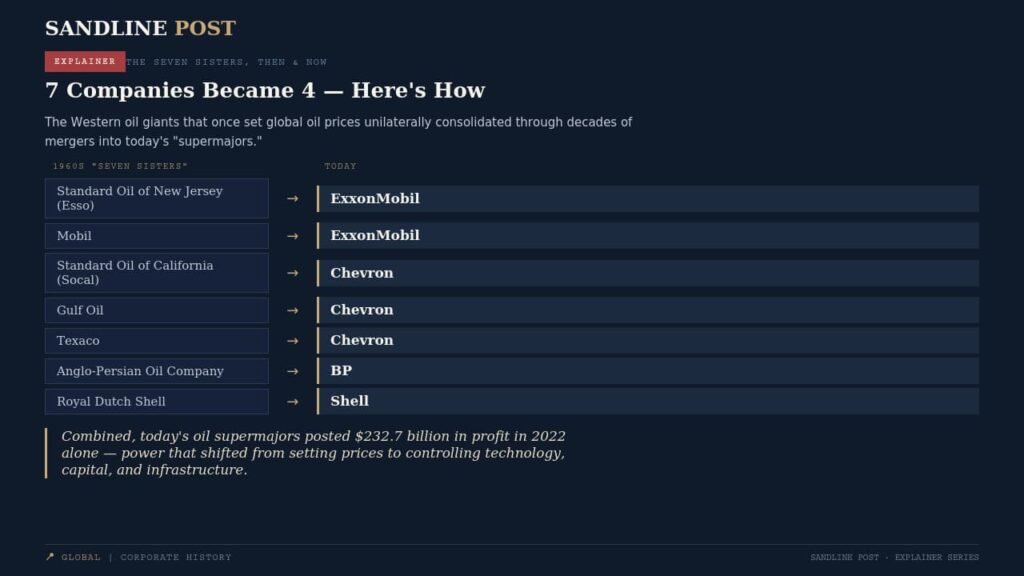
The companies that once controlled global oil pricing are still around, just fewer of them and doing something different. Through decades of mergers, the original seven consolidated into four supermajors: ExxonMobil (Standard Oil of New Jersey plus Mobil), Chevron (absorbing Standard Oil of California, Gulf Oil, and Texaco), BP (from the Anglo-Persian Oil Company), and Shell, which mostly stayed intact.
None of them set prices anymore — that’s OPEC’s job now. Instead, they’ve become partners: providing drilling technology, engineering, and capital to producing nations in exchange for a cut of output or profit.
Most are also pushing into gas and renewables as the industry shifts. They haven’t gotten smaller in any meaningful sense, though — the top oil majors posted a combined $232.7 billion in profits in 2022 alone.
Why Don’t Producing Countries Just Cut Out the Middleman?
Fair question, and the honest answer is: some already have, and others aren’t quite there yet.
The case for keeping a partner comes down to a few practical realities. Complex fields — deep offshore reserves, high-pressure sites like Kazakhstan’s Tengiz, shale formations — need engineering built up over a century of trial and error that can’t just be conjured.
Developing a new field costs billions, and Western companies often front that money and the risk that comes with it, in exchange for a share of future output. Getting crude out of the ground is also only half the job; refining it and moving it to global markets requires infrastructure most producing nations haven’t built themselves.
And full nationalization carries real political risk — Iran found that out the hard way in the 1950s, when its attempt triggered a Western-backed coup.
But going independent is possible, and Saudi Arabia is the proof. Saudi Aramco started as a Chevron partnership in the 1930s. Over decades, Saudi Arabia built its own technical bench and gradually nationalized the company, finishing the process by 1980. Today Aramco is one of the most valuable companies on Earth, fully Saudi-owned, no longer leaning on Western partners for its core operations.
The pattern seems to be: enough time, enough capital, enough political will, and a country can eventually go it alone, the way Saudi Arabia did. Countries newer to the business, or under pressure to move fast — Kazakhstan, Venezuela — tend to stay in partnership arrangements instead, trading some ownership for speed and lower risk.
The Bigger Picture
Understanding what is OPEC and OPEC+ today means recognizing a slow power shift that’s nowhere near finished. It began as developing nations trying to claw pricing control away from a handful of Western companies.
Six decades on, that relationship has flipped from control to partnership, but the underlying tension — independence versus practicality — never actually went away. It just moved from boardrooms in London and New York to negotiating tables in Riyadh, Vienna, and Moscow.